Related pages
Introduction to the Book of Exodus
The Book of Exodus begins the history of Israel as a nation. At the end of the Book of Genesis the family of Jacob move down from the land of Canaan to Egypt. A large family with a total of seventy people came (Gen 46:27). During the years between Genesis and Exodus, this large family multiplied until their numbers became a threat to the rulers of Egypt (Ex 1:7-10). According to the census taken in the book of Numbers, there were 603,550 adult males belonging to the twelve tribes of Israel (Num 1:46). Including women and children, we can estimate that the total population of Israelites was between two and three million.
The book has two main parts. The first is the account of the actual exodus from Egypt, including the ten plagues, the crossing of the Red Sea and the journey to Mt Sinai. The second contains the making of the covenant and giving of the law on Sinai, and the rebellion of the golden calf while Moses was up the mountain receiving the instructions for the tabernacle. The climax of the book is right at the end when the people construct the tabernacle and it is filled with the glory of God (40:34), so God can literally dwell in the midst of his people.
Where did the Israelites live while in Egypt?
When Egypt is viewed from space it is very clear that most of the land is desert, apart from a narrow strip of fertile land adjacent to the River Nile, and around the delta of the Nile where it divides into many smaller channels as it flows into the Mediterranean Sea.
According to the Book of Genesis, "Joseph settled his father and his brothers, and granted them a holding in the land of Egypt … in the land of Rameses" (Gen 47:11). In the Book of Exodus, "They built supply cities, Pithom and Rameses, for Pharaoh" (Ex 1:11). The land of Rameses is likely to be a later name for an earlier settlement, where the Israelites settled and lived during their time in Egypt.
An Austrian team of archaeologists led by Manfred Bietak excavated a site called Tell el-Dab’a, which was originally the Hyksos capital of Avaris. By 1446 BC, city was called Perunefer, which means 'happy journey', probably because it was the start of overland route to Canaan, the Horus Road, or the "Way of the Philistines" (Ex 13:17). It was renamed Rameses in 13th cent BC, by Rameses II. It was an important commercial and military centre, as well as being a seaport, with access to sea by Pelusiac branch of Nile, which is the delta channel furthest to the east.
The location can be seen on the map of the Nile Delta or on an aerial view of the site.
The majority of the houses that have been excavated are homes with two rooms measuring 6m by 8m. There was one larger four-room house measuring 10m by 12m. This had two side rooms, and a back room around a central courtyard, the same plan as iron-age houses in Israel. The date of the houses is estimated to be during the 19th century BC, the time of Jacob and Joseph, so it is suggested that the larger house may have belonged to Joseph.
To the South-west was the cemetery, which had mud-brick tombs with Asiatic contents, including pottery. One tomb was much larger, and unlike any other tomb in Egypt, and probably belonged to an important asiatic official. It had a burial chamber reached through a chapel and passage, where fragments of a statue were found. It is possible that this was the tomb of Joseph. There was no body in the burial chamber, which would match with Joseph's instructions that they take his body back to Israel (Gen 50:25, Ex 13:19).
The statue was one and half times life-size, and was of a seated official. The face had been defaced. The features were quite different from typical Egyptian statues, with a yellow skin colour, a mushroom-shaped hairstyle, and a multicoloured coat. He was holding a throwstick, which would indicate that the person was not an Egyptian.
The Palace of Pharoah
Also found in Tell el-Dab'a, adjacent to the Pelusiac branch of the Nile was a complex of buildings built with mud bricks, influencing two major palaces, workshops, military areas, storage and religious cultic facilities. The walls of the palace were three meters thick, suggesting they supported a huge structure.
If this was the palace of Pharaoh, it would have been the location where “The daughter of Pharaoh came down to bathe at the river” (Ex 2:5), and where Moses would have been brought up after being adopted by Pharaoh's daughter, “Moses was instructed in all the wisdom of the Egyptians” (Acts 7:22). Later, it was where Moses met the Pharoah during the plagues, “Go to Pharaoh … as he is going out to the water, stand by the river bank to meet him … Moses struck the water and it was turned to blood" (Ex 7:15, 20).
In the palace, a limestone bath with a drain was found, together with a vessel to contain water. This was where people with official business would wash before entering the presence of Pharaoh. After being released from prison Joseph would be washed (Gen 41:14), and later Moses and Aaron would have to wash before entering presence of Pharaoh (eg Ex 5:1).
Identifying the Pharaoh
The word 'Pharaoh' was the title of the Egyptian ruler, so does not identify a particular person. There are two pharaohs to be identified in the book:
1. The Pharaoh who oppressed the Israelites (Ex 1).
This was the ruler who did not know Joseph (Ex 1:8) and forced the Israelites into slave labour to build supply cities (1:11). He commanded that the baby Israelite boys were thrown into the river, but it was his daughter who adopted Moses (Ex 2:5-10). He evidently ruled a long time, “After a long time the king of Egypt died” (Ex 2:23).
2. The Pharaoh of the Exodus
This was the ruler who refused to let the Israelites go, and hardened his heart. His eldest son died in the final plague (Ex 12:29). It is likely that he was drowned in the Red Sea (Ex 14:23). In the Psalms, it says, "The Lord … overthrew Pharaoh and his army in the Red Sea" (Ps 136:15).
Working out the date of Exodus
Egyptian history is divided up according to the number of the dynasty of the Pharaoh's, from the first dynasty to the 31st dynasty, each dynasty containing a number of rulers from the same family line.
There are many debates and contentions over the date of the Exodus, with a number of different suggestions.
Many scholars claim that the exodus from Egypt is merely a legend. Instead of a dramatically large movement of people at one time, the Israelites gradually moved back to Israel from Egypt in smaller numbers. This removes the need to attempt to date the Exodus.
Late date during the 19th dynasty in the 1200's BC.
This gives a shorter time span between the entry into the Promised Land and the time of the monarchy under David. There is not much doubt over the date of David's reign and the establishment of the monarchy of around 1000 BC. A late date exodus would compress the chronology of the period of the judges to about 200 years. It is quite likely that there could be two or more judges ruling over different tribes at the same time, as each judge only ruled over a few tribes, rather than the whole nation.
A late date for the Exodus would suggest that the family of Jacob came to Egypt in 1700’s BC. This was during the period when Egypt was ruled by the Hyksos, who were a Semitic people who would perhaps welcome the Israelites as fellow Semites. It would also explain why the Pharaoh did not know about Joseph (1:8). The cities of Pithon and Rameses (Ex 1:11) built by Israelites. Rameses II belonged to the 19th dynasty and ruled 1290-1224 BC, and the city was named after him. Merneptah’s Stele contains the first mention of Israel in history outside the Bible, and records a successful Egyptian battle against Israel in 1220 BC.
For a late date Exodus, the Pharaoh who oppressed the Israelites would be Rameses II. He is known to have been a powerful ruler. Merneptah (1224 - 1214) would then be the Pharaoh of the Exodus.
Early date during the 18th dynasty in the 1400's BC.
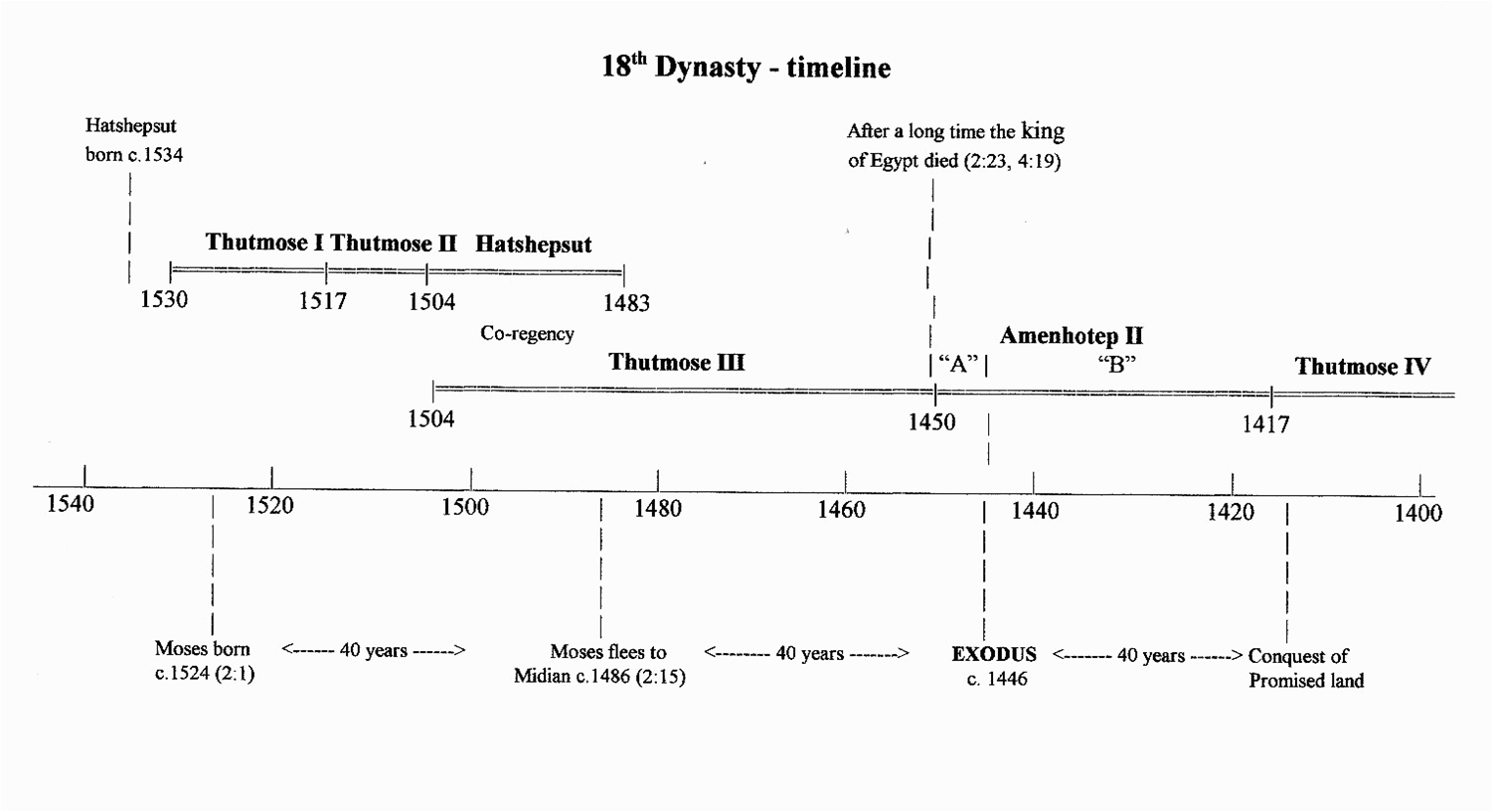
The early date gives a longer time span for the period of the judges, which would match the dating noted in the Old Testament. According to the Book of Kings, they began to build the temple, "In the 480th year after the Israelites came out of Egypt, in the fourth year of Solomon’s reign over Israel …" (1 Kg 6:1). Solomon became king around 970 BC, so his fourth year would be 966 BC, setting the date of the Exodus around 1446 BC, and the entry into the Promised Land forty years later in 1406 BC.
A similar chronology is described in the Book of Judges, when referring to the time of Jephthah, "Israel lived in Heshbon … Aroer …, and all the towns that are along the Arnon, three hundred years …" (Judges 11:26).
Evidence for a early date would be found in the Tel-el-Amarna tablets. These were from the time of Akhenatan (1350-1330) and his father Amenhotep III in the 18th dynasty. In these, Canaanite vassals of Egypt write asking for help against the Hittites and marauders called 'Habiru', from the hill country. It is suggested that the Habiru are referring to the Hebrews entering the Promised Land.
The early date oppressor would be Thutmose III (1490-1437), and the Pharaoh of the Exodus would be Amenhotep II (1450-1417).
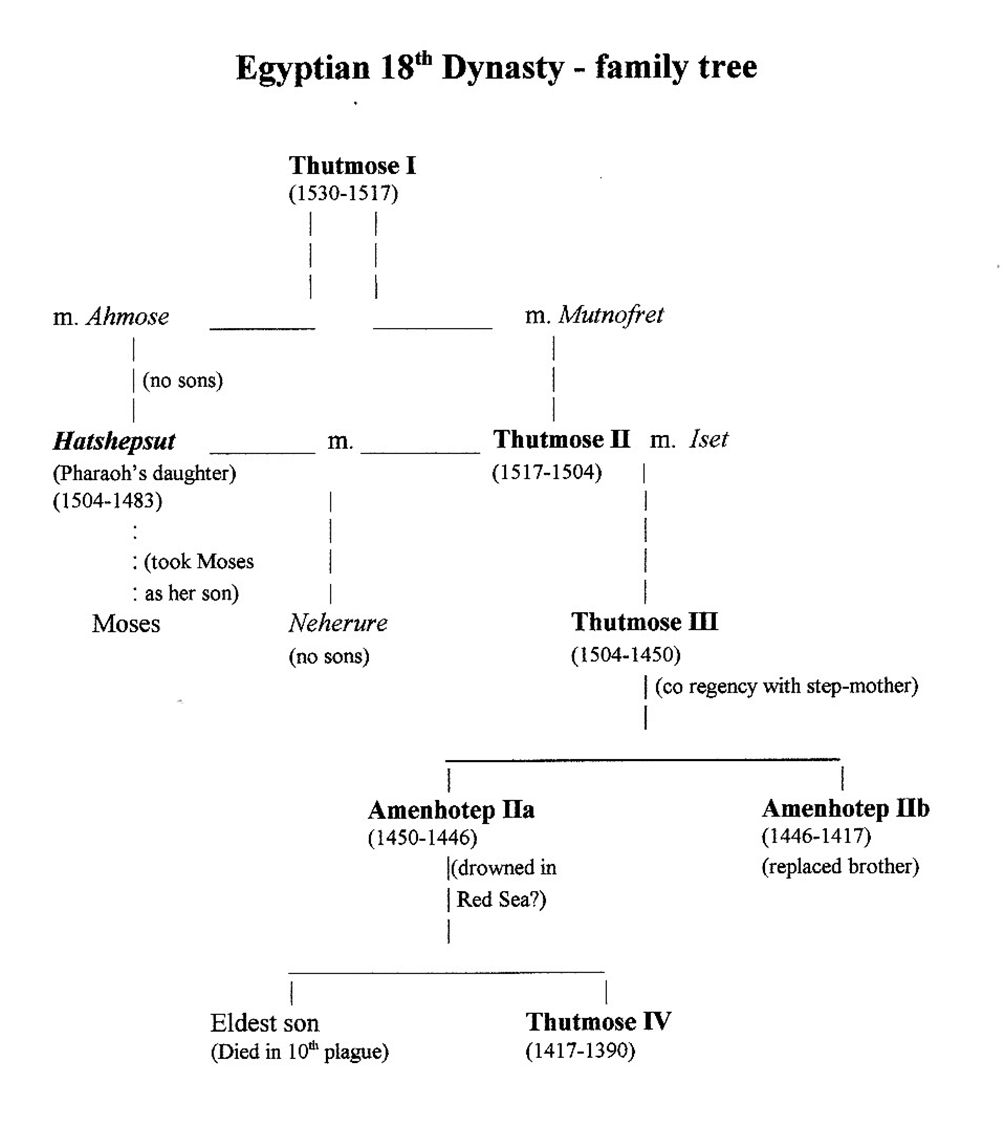
It has been suggested that there were actually two Amenhotep II's. The first ruled from 1450 to 1446, who died by drowing in the Red Sea, and whose son died in the final plague. The second ruled from 1446 to 1417 replacing his brother as pharaoh. The first Amenhotep II was famous for his personal strength, athletic abilities, bravado, skill as horseman, archer, runner and rower. He was boastful and arrogant. It has been suggested that his death was covered up by his officials, as the great god-king could not die pursuing runaway slaves. He was replaced as pharaoh by his brother, who took the same name.
Inscriptions describing the second Amenhotep II are not boastful or bragging, suggesting that he had quite a different character.
A pharaoh called Amenhotep II led a number of campaigns into Asia. One was in the second year (before the Exodus) when 800 captives were brought back. There was another campaign in the seventh year (after the Exodus), but both campaigns were referred to as the first campaign. This could suggest that the campaign in the second year was led by the first Amenhotep II, and the one in the seventh year by the second Amenhotep. Another campaign in the ninth year, brought back 89,600 captives, perhaps to replace slave workforce lost when the Israelite slaves left Egypt. His tomb has been found in the Valley of the Kings in Luxor.
Around this time, the city of Perunefer was suddenly abandoned, perhaps as a result of the plagues and the Exodus of the Israelites.
Another suggestion was that the daughter of pharaoh who rescued Moses was Hatshepsut (born 1533 BC). She married her half-brother Thutmose II, but had no sons. After Thutmose II, she reigned as co-regent for her infant step-son Thutmose III. She took the name and title as king, setting up obelisks and making offerings to the gods. She is portrayed as king, with a royal beard. She as the only woman who could have had the title 'Pharaoh’s daughter' during this period. She was described as a "A strong-willed woman who would not let anyone or anything stand in her way”. If she wanted to adopt an Israelite baby, no one would have been able to prevent her. She died in 1483, perhaps by murder. Later, images portraying her were obliterated, perhaps because she had brought up Moses, who had caused such a disaster to come to Egypt.
Revised Egyptian Chronology
Some recent scholars have claimed that the whole chronology of Egyptian history should be revised. One of these is David Rohl, who claims that the Third Intermediate Period (TIP), from the 21st to the 25th dynasties, which he calls 'The Centuries of Darkness', does not exist, so should be removed from Egyptian history. This shortens the period of Egyptian history by between 300 and 500 years. He would give an early date for the Exodus in the 1400's BC, but in the 12th dynasty, rather than the 18th dynasty.
The revised chronology oppressor would be the rather grumpy looking Sesostris III in the 12th dynasty, and the pharaoh of the exodus would be Amenemhet III, who ruled for 46 years. No body was found in his tomb, perhaps because he drowned in the Red Sea pursuing the Israelites. His daughter was Sobekneferu, one of the very few female pharaohs, the final leader of the 12th dynasty, who may have been the daughter of pharaoh who found baby Moses in the river.
Red Sea or Sea of Reeds?
The Hebrew for the Red Sea is 'Yam Suph', which is often translated 'Sea of Reeds'. Many scholars claim that this implies that the Red Sea crossing was through a smaller, shallower piece of water or marshland, rather than the open sea, and therefore not particularly miraculous. It is often suggested that the reeds are describing fresh water plants and that the Israelites crossed one of the smaller lakes north of the Gulf of Suez.
Yam Suph describes the Red Sea in the following places: "The LORD changed the wind into a very strong west wind, which lifted the locusts and drove them into the Red Sea (Yam Suph)" (Ex 10:19). "So God led the people by the roundabout way of the wilderness toward the Red Sea (Yam Suph)" (Ex 13:18). "I will set your bounds from the Red Sea (Yam Suph) to the sea of the Philistines and from the wilderness to the Euphrates" (Ex 23:31).
After the rebellion in the wilderness, God commanded, "Now since the Amalekites and Canaanites live in the valleys, turn tomorrow and set out for the wilderness by way to the Red Sea (Yam Suph)" (Num 14:25, also Deut 1:37-40). "From Mount Hor they set out by the way to the Red Sea (Yam Suph) to go around the land of Edom" (Num 21:4, also Deut 1:46 - 2:1).
"King Solomon built a fleet of ships at Ezion-geber, which is near Eloth on the shore of the Red Sea (Yam Suph) in the land of Edom" (1 Kg 9:26). Eloth is near the modern town of Eliat at the top of the Gulf of Aqaba, the right hand fork of the Red Sea. So Yam Suph is referring to the Gulf of Aqaba. With the help of the Phoenicians, Solomon built a fleet of ships to trade to the east, including to the east coast of Africa, and to India and beyond.
Interestingly the same word (suph) is used in the book of Jonah to describe sea vegetation, "The waters closed in over me; the deep surrounded me; weeds (suph) were wrapped around my head" (Jonah 2:5).
The concept of a sea of reeds was also significant to the Egyptians. One of the tasks of the pharaoh was to be the one who leads his people through the waterways of the Sea of Reeds into the afterlife along a pathway opened by the gods. In the Exodus account, pharaoh failed to lead his people through the sea of reeds, while Yahweh opened the way for the Israelites through the sea of reeds.
The geographical location of the crossing of the Yam Suph should probably be identified as one of the two branches at the northern end of what is known today as the Red Sea, the Gulf of Suez to the west of the Sinai Peninsula, or the the Gulf of Aqaba to the east of the Sinai Peninsula.
The Route of the Exodus
Numbers chapter 33 gives a list of the camping places over the forty years from leaving Egypt to the land of Edom, immediately before the entry to the Promised Land (Num 33). It is very difficult to trace the exact route, as the location of these places is not at all certain. This is particularly because people camping for brief periods and quickly moving on do not leave any archaeological remains.
Again, there are a number of different opinions concerning the route of the Exodus. These are particularly based identifying the location of Horeb, or Sinai, the mountain of God. The location of the Red Sea crossing will then be determined by the choice of the location of Sinai.
1. The traditional route - the Sinai Peninsula
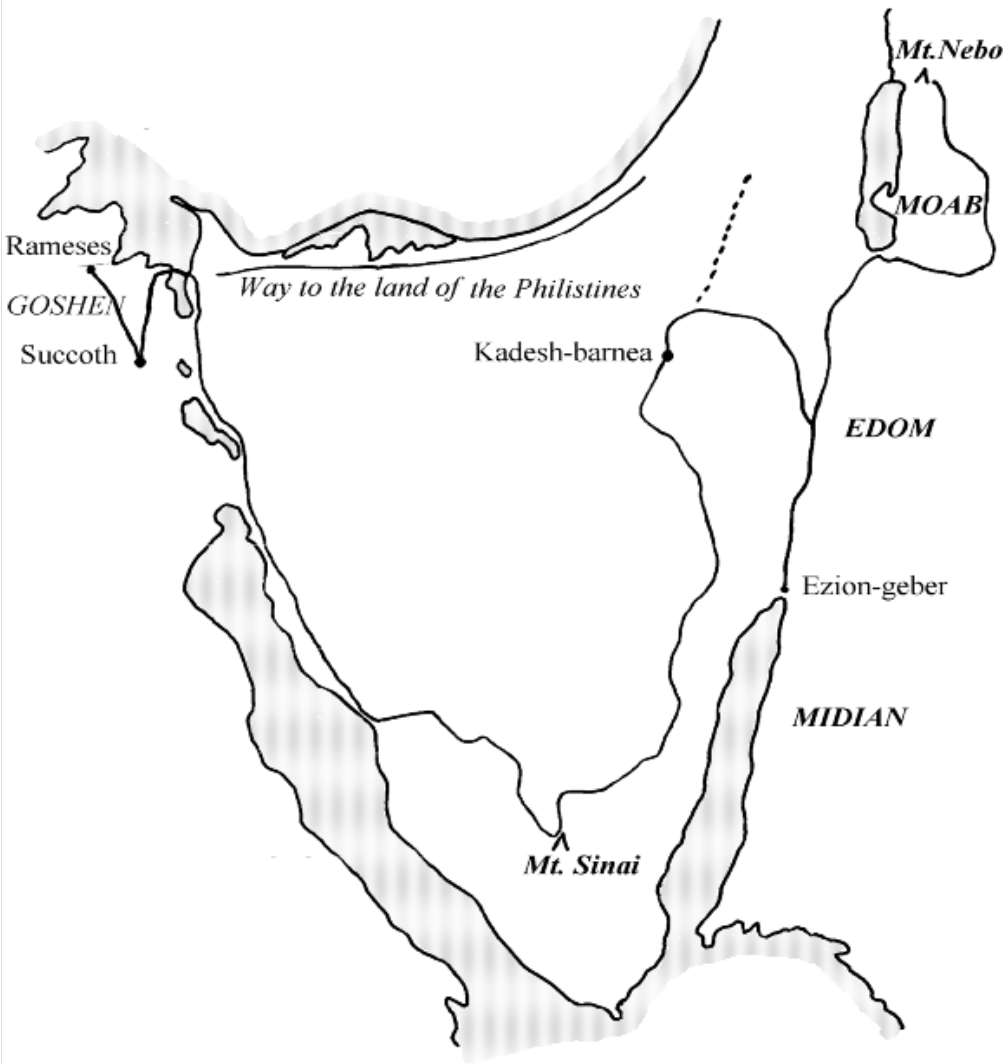
The traditional location of Horeb, or Mt Sinai, is now known as 'Gebel Musa', one of the highest points towards the south of the Sinai Peninsula, with St Catherine's Monastery lying below, which is claimed to have been built on the site of the burning bush.
2. Horeb in Midian - north-western Saudi Arabia
The Book of Exodus states that Moses met with God at the burning bush at Horeb in Midian, which is east of the Gulf of Aqaba. "Moses was keeping the flock of his father-in-law Jethro, the priest of Midian; he led his flock beyond the wilderness, and came to Horeb, the mountain of God. There the angel of the Lord appeared to him in a flame of fire out of a bush." (Ex 3:1-2). It will to this same location that Moses was told to bring the Israelites, "When you have brought the people out of Egypt, you shall worship God on this mountain. (Ex 3:12). Also at Horeb, is the location of the water out of the rock, "I will be standing there in front of you on the rock at Horeb. Strike the rock, and water will come out of it, so that the people may drink." (Ex 17:6). This is also where Moses met with Jethro, "Jethro, Moses’ father-in-law, came into the wilderness where Moses was encamped at the mountain of God." (Ex 18:5).
If Sinai is located in Midian, then the route of the Exodus would be quite different. The Red Sea crossing would be at the southern end of the Gulf of Aqaba, at the Straits of Tiran. This is a relatively narrow and shallow entrance to the Gulf of Aqaba. From Egypt, the route would run along the relatively flat western side of the Sinai Peninsula, beside the Gulf of Suez to the southern tip, where the modern resort of Sharm al Sheikh is located. Beyond this, the Israelites would have become trapped before mountainous terrain as they were pursued by the army of Pharaoh (Ex 14:1-9). At the time of the Exodus, the whole of the Sinai Peninsula was under the control of Egypt.
The Israelites were told to "… camp in front of Pi-hahiroth (mouth of the .. water?) between Migdol and the sea, in front of Baal-Zephon" (Ex 14:2,9). "They set out from Etham, and turned back to Pi-hahiroth, which faces Baal-zephon, and they camped before Migdol" (Num 33:7). On the eastern side of the Strait of Tiran is a prominent mountain, clearly visible from the western side, which may be identified as Baal-zephon.
The mountain of God would be indentified with 'Jabal al Lawz' in north-western Saudi Arabia. Although this site is extremely difficult to access, there are some very interesting things to note about it. Firstly the rocks at the top of the mountain are blackened, as if by fire. Nearby is a dramatic split rock which could well be the site of where God provided water (Ex 17:1-6).
On the east shore of the Gulf of Aqaba is a location known as the 'Springs of Moses'. This may the location of Elim, "where there were twelve springs of water and seventy palm trees" (Ex 15:27).
Related pages