Related pages
The hidden hand of God
Together with the Song of Solomon, the Book of Esther contains no mention of any of the names or titles of God. By contrast the king of the Persians is mentioned 192 times, the kingdom of the Persians 26 times, and his name 'Ahasuerus' occurs 29 times.
Although God’s name is never mentioned, there is a veiled reference to God. "For if you keep silence at such a time as this, relief and deliverance will rise for the Jews from another quarter ... Perhaps you have come to royal dignity for just such a time as this." (4:14).
Yahweh acrostics
It has been noted that the holy name of God, the tetragrammaton YHWH, appears four times in acrostic form (1:20, 5:4,13, 7:7). In Hebrew, YHWH consists of the four consonants Yod, He, Vav, and He. In English, this is normally written as YHWH, but would be YWVH in Hebrew. This is known as the 'hidden hand' in the Book of Esther. In two occasions it is spelled backwards (1:20, 5:13), and the other two occasions it is spelled forwards (5:4, 7:7). When YHWH is spelled backwards, God is overruling the plots of the Gentiles in order to accomplish his own plans. When his name is spelled forwards in the normal order, God is working directly for the interests of his own people, even though his work is hidden from sight.
In two occasions the acrostic is the first letters of the word (1:20, 5:4), and the other two occasions the acrostic is the final letter of the word (5:13, 7:7). In the two occasions where the initial letters form the name YHWH show God initiating actions which will overrule the plots of the Gentiles. When the name of YHWH is formed by the final letters, the events are also final, leading towards the final victory that God would achieve.
There are several ancient Hebrew manuscripts of the Book of Esther in which the letters of YHWH in these four acrostics are written in a larger font than the other letters, known as Majuscular letters, rather like capital letters, so they stand out prominently. In the Hebrew Masoretic Text, there are notes known as the Massorah, drawing attention to these acrostics.
Each acrostic is spoken by a different speaker. The first is said by Memucan, one of the seven officials of Persia and Media, a Gentile (1:20), the the second is said by Esther, a Jew (5:4), the third by Haman, a Gentile (5:13), and the fourth by the narrator, a Jew (7:7).
This shows that Divine providence is at work in the story of Esther and the preservation of the Jews, even though God is not explicitly mentioned.
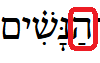
First acrostic (1:20) "all women will give"
The acrostic uses the initial letters of each word, but is spelled backwards (left to right in Hebrew). It uses initial letters because God is initiating the action, the backward spelling shows he is rolling back and overruling over affairs of mankind.
 |
 |
 |
 |
| Y |
H |
V |
H |
| they will give |
the women |
and all of |
she |
Second acrostic (5:4) "let the king and Haman come"
The acrostic uses initial letters of words spelled forwards (right to left in Hebrew). Again the initial letters show that God is initiating the actions. The normal forward spelling shows that God is ruling and causing Esther to act by the invitation to the banquet, the first step in God's plan.
 |
 |
 |
 |
| H |
V |
H |
Y |
| this day |
and Haman |
the king |
let come |
Third acrostic (5:13) "this does me no good"
This acrostic uses the final letters of each word, but spelled backwards (left to right in Hebrew). The use of final letters in the acrostic shows that the end of the plot was coming. The backward spelling shows that God was overruling Haman's delight in receiving the invitation, and turning back his plot.
 |
 |
 |
 |
| Y |
H |
V |
H |
| this |
does |
nothing |
to me |
Fourth acrostic (7:7) "evil was determined against him"
The acrostic uses the final letters of each word spelled forwards (right to left in Hebrew). Again, the use of the final letters in the acrostic shows that Haman's end had come, and the use of the normal forward spelling shows that the sovereign God was in control, and bringing the conclusion that he had determined.
 |
 |
 |
 |
| H |
V |
H |
Y |
| evil |
against him |
was determined |
that |
'I AM' acrostic
The fifth acrostic (7:5) - the 'I AM' "Who is he, and where is he?"
The acrostic uses the final letters of each word spelled forwards (right to left in Hebrew). Instead of the holy name for God, YHWH, this has the letters EHYH, meaning 'I AM'. This is also noted in some manuscripts by the use of Majuscular (capital) letters. The acrostic is formed by the final letters, and the name is spelled backwards.
King Ahasuerus asks Esther, "Who is he, and where is he, who has presumed to do this?". Esther's reply is, "A foe and enemy, this wicked Haman!" (7:5), who plotted to destroy the Jews. Without realising it, by asking the question, Ahasuerus actually states the personal name of the God who delivered his people out of slavery in Egypt, from the hand of Pharaoh. Haman, as the enemy of the Jews, was acting like the Pharaoh of Egypt to destroy the Jewish people. The Israelites suffering in Egypt cried out for help, and their cries were heard by God (Ex 2:23-25). When God appeared to Moses at the burning bush, and Moses asked what his name was, the answer was, "I AM WHO I AM" (Ex 3:14). As in Egypt, through Haman, Satan was again attempting to destroy the Jews and prevent the coming of the Messiah. Ahasuerus was asking which person was plotting to destroy the Jews, but only the 'I AM' really knew that Satan was directing the Haman's plans. The great 'I AM' is about to deliver the Jews from Haman, just as he had delivered the Israelites from Egypt.
 |
 |
 |
 |
| H |
Y |
H |
E |
| this man |
where is |
this man |
who is |
Reversal of Haman's plot
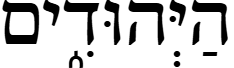
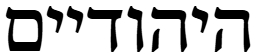
The word 'Jew' appears eight times, and only twice in the rest of the OT, and the plural form 'Jews' appears 47 times in Esther and 27 times in the rest of the OT. In the Hebrew text, there are six places where the word 'Jews' is spelled in an unusual way, with a double yodh (4:7, 8:1,7,13, 9:15, 18), instead of a single yodh. The yodh looks a bit like a single quotation mark. In the images below it is the second character from the left for the single yodh, and the second and third characters for the double yodh. As Hebrew is written from right to left, the yodh is the penultimate character of the usual word for 'Jews'.
| 'Jews' with single yodh |
 |
| 'Jews' with double yodh |
 |
The words for 'hand' and for 'Yahweh' both begin with a yodh, which suggests that the author has used the unusual spelling of 'Jews' to show that the hand of Yahweh was over his people, without mentioning his name.
Each of the six times the double yodh is used there is a link with the reversal of the plot of Haman against the Jews. In the passages quoted below the word Jews in bold indicates the use of the double yodh.
1. Haman to fund the plot (4:7)
The first use begins the reversal of Haman's plot as Mordecai mentions the money that Haman had promised to the king for his plot against the Jews. "And Mordecai told him (Hathach the king's eunuch) all that had happened to him, and the exact sum of money that Haman had promised to pay into the king's treasuries for the destruction of the Jews" (4:7).
2. Stealing the possessions of the Jews (8:1)
Haman's house was given to the Jews. "On that day King Ahasuerus gave to Queen Esther the house of Haman, the enemy of the Jews" (8:1). Instead of Haman looting the possessions of the Jews, his own house became the property of the Jews.
3. Hanging Mordecai (8:7)
Haman was hanged on the same gallows that he built to hang Mordecai. "See, I have given Esther the house of Haman, and they have hanged him on the gallows, because he plotted to lay hands on the Jews" (8:7).
4. Killing the Jews (8:17)
Haman's original plan to kill the Jews as written as an edict and distributed to all the provinces (3:12-13). A new decree is now being issued and distributed to negate the effects of the original decree.
"A copy of the writ was to be issued as a decree in every province and published to all peoples, and the Jews were to be ready on that day to take revenge on their enemies" (8:17).
5. Scattering the Jews (9:15)
Haman had complained that the Jews were scattered all about the kingdom (3:8). This situation was now being reversed as the Jews gathered to defend themselves. "The Jews who were in Susa gathered also on the fourteenth day of the month of Adar and they killed three hundred persons in Susa ..." (9:15)
6. Complaint about Jews not obeying the king (9:15)
The Jews finally gather as a unified nation to celebrate Purim. Haman had complained about the Jewish religious practices and the failure to observe the Persian laws (3:8). The final reversal is when the Jews are given a new festival to celebrate as a result of the failure of Haman's plot. "But the Jews who were in Susa gathered on the thirteenth day and on the fourteenth, and rested on the fifteenth, making that day of feasting and gladness." (9:18).
Related pages