Related pages
Jeremiah the prophet
We know far more about the life of Jeremiah than any other prophet. In his book, Jeremiah exposes his personal feelings, his personal relationship with God, as well as his inner conflicts, as well as his physical and emotional suffering.
Jeremiah was a lonely rejected figure, who was not understood or appreciated. He was rejected by his neighbours in Anathoth (11:21), his family (12:6), his friends (20:12), the priests (20:1-2), the prophets (26:8), all the people (26:8), and even the king (36:23). He had a life of threats and persecution, spending a night in the stocks, and being thrown into mud-filled cistern and left to die. He had periods in prison, and was put on trial for his life. The people of his home town plotted to take his life, because he was considered a traitor. He was hated by King Jehoiakim, opposed by the priests and the false prophets. He was called to a life of singleness as a prophetic statement.
Most of the information recorded is of his call to be a prophet in 627 BC, and from the time after the death of Josiah in 609 until the fall of Jerusalem in 587 BC. Because many oracles are undated, some may be from the period before 609 BC.
Jeremiah’s family background
Jeremiah was born in Anathoth, a small town three miles north-east of Jerusalem. This was a Levitical city within the territory of Benjamin (Josh 21:18). He was born into a priestly family, son of Hilkiah, a different person from Hilkah the high priest. A priest not based in Jerusalem would have been deprived of their priesthood and ministry by Josiah's reformation, which called for centralised worship in Jerusalem. Because Jeremiah supported this, his family opposed him. The priests who were in Anathoth (1:1) were probably those descended from Abiathar, who had supported Adonijah to be king after the death of David (1 Kings 1:5). Solomon expelled him to Anathoth, even though he deserved death (1 Kings 2:26). This action fulfilled the word concerning the house of Eli in Shiloh (1 Kings 2:27), which may explain Jeremiah's interest in Shiloh (ch 7). Jeremiah’s family could trace their descent from Eli and Aaron, giving them a strong heritage of the priesthood and the traditions of the covenant.
Jeremiah’s call to be a prophet was in the thirteenth year of Josiah (1:2), 627 BC. At this time he was a young unmarried man, probably between sixteen and twenty years old (1:6), so he was probably born between 645 and 640 BC, at the end of the reign of the evil king Manasseh. He was approximately the same age as King Josiah.
We have no information about Jeremiah’s childhood, but he would have certainly been trained in the great traditions of Israel's faith and history. There is no evidence for Jeremiah being trained for, or ministering as priest. However, coming from a priestly city, he would be familiar with the duties of the priesthood and way they were being ignored. He would be grieved that the priests of his time were not teaching the Law of God, but were supporting the pagan idolatry of Manasseh and Amon. As a young Jew, he would also be very familiar with the great stories of past, particularly the exodus. His book also shows a connection with the language and thought of Hosea, who prophesied in the previous century. He probably had a traditional and conservative background, and living near Jerusalem, would be aware of the political events of his time. He was probably became sensitive to Yahweh at an early age, hating the idolatry that surrounded him, which prepared him for his call to prophetic ministry.
Historical Background of Jeremiah’s ministry
Jeremiah’s ministry was during a time of great political and religious crisis in Judah, and complete ferment in the whole Middle East. During his life, the Assyrian empire collapsed, to be replaced by Babylon, Egypt declined in power, and Judah was wiped off the map. This period is described in 2 Kg 18-25 and 2 Chr 29-36.
Final kings of Judah - Family tree
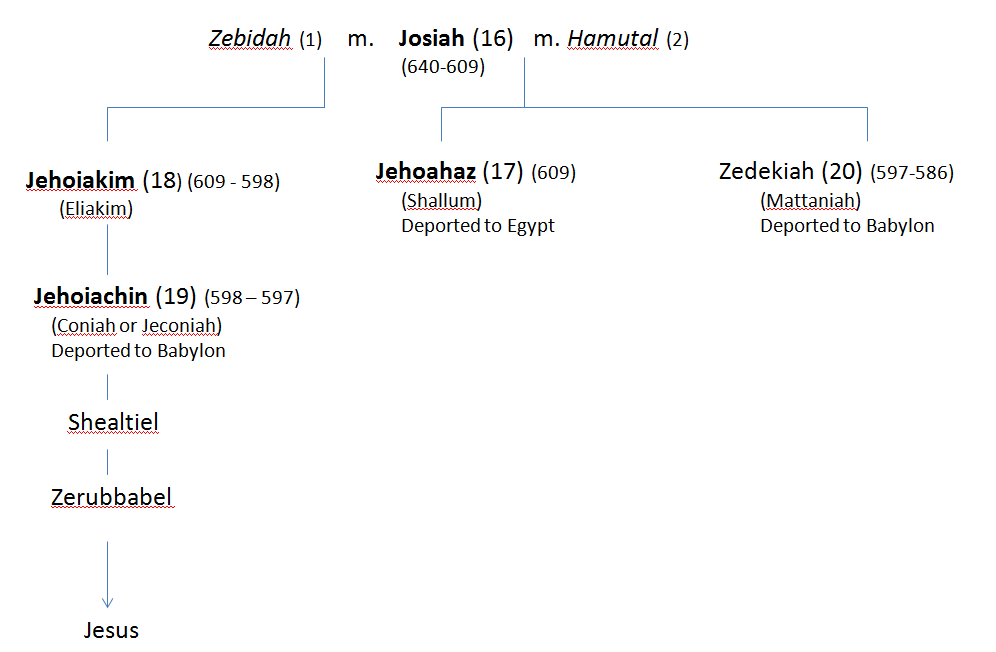
Key Events in Jeremiah's Time (2 Kg 18 - 25, 2 Chr 29 - 36)
| 640 |
Josiah became king |
| 632 |
Josiah started to seek God |
|
627 |
Josiah started his reforms
Jeremiah called to be a prophet |
|
626 |
Death of Ashurbanipal - Assyria declined rapidly
Judah: period of independence - Josiah free to reform
Babylon: independent under Nabopolassar - threat to Assyria
Egypt: grew stronger under Psammetichus I |
|
621 |
Book of law discovered in temple. Josiah repented, reformation grows. Passover celebrated |
|
617 |
Attacks by Babylon and Medes on Assyrian cities |
|
612 |
Nineveh fell to Medes and Babylonians. Remnant of Assyria allied to Egypt |
|
609 |
Josiah killed at Megiddo (2 Kg 23:29), succeeded by Jehoahaz.
Judah became vassal of Egypt - Collapse of reforms.
Jehoahaz king for three months, then taken to Egypt by Pharoah Necho.
Jehoiakim - vassal king under Egypt |
|
605 |
Battle of Carchemish - Egypt defeated by Babylon. Babylon becomes world power |
|
604 |
Nebuchadnezzar attacked Philistine cities and Judah, and surrounded Jerusalem.
Judah became a vassal of Babylon.
Small deportation of able young men (including Daniel & friends) (First deportation) |
|
601 |
Nebuchadnezzar defeated near Egypt |
|
598 |
Judah made alliance with Egypt. Babylon attacked Judah. |
|
597 |
Three month siege of Jerusalem. Jehoiakim died.
Jerusalem fell in March 597, but was not destroyed.
Jehoiachin deported to Babylon, with skilled & educated people (including Ezekiel), leaving only the poorest in the land. (Second deportation)
Zedekiah king as vassal of Babylon. |
|
594 |
Uprising in Babylon. Egypt planned rebellion against Babylonia, tried to persuade Zedekiah to join. |
|
588 |
Zedekiah, under pressure of officials, rebelled against Babylon by joining alliance with Egypt.
Judah invaded & cities destroyed by Babylon. Jerusalem besieged for18 months.
Brief lull in siege when Egypt came to help.
Babylon sent forces from siege against Egyptian army, relieving Jerusalem. |
|
587 |
Babylonian army breaks into Jerusalem.
Zedekiah's sons were killed in front of him, before he was blinded and taken into exile in Babylon, where he died.
Most people deported (only very poor left), city burned, temple destroyed (including ark of the Covenant) (Third deportation)
Gedaliah made governor. Murdered after three months.
Jews fled to Egypt, taking Jeremiah with them. |
|
582 |
Fourth and final deportation of poorest of poor. |
Dated passages
A number of sections and events in the book are given dates. It should be noted that these are not in chronological order.
| Reference |
Date BC |
Event |
| 1:1 | 627 BC | Call of Jeremiah |
| 7:1 | 609 BC | Temple sermon |
| 21:1 | 587 BC | Words to Zedekiah |
| 24:1 | 598 BC | Baskets of figs |
| 25:1 | 605 BC | Summary of message |
| 26:1 | 609 BC | Temple sermon and trial |
| 27:1 | 594 BC | Message of yoke bar |
| 28:1 | 594 BC | Message to Hananiah |
| 29:1 | 598 BC | Letter to exiles in Babylon |
| 32:1 | 588 BC | Purchase of field |
| 34:1 | 588 BC | Message to Zedekiah |
| 35:1 | 605 BC | Faithful Rechabites |
| 36:1 | 605 - 604 BC | Burning the scroll | |
| 37:1 | 587 BC | Zedekiah consults Jeremiah |
| 39:1 | 586 BC | Fall of Jerusalem |
| 45:1 | 605 BC | Word for Baruch |
| 46:1 | 605 - 604 BC | Oracle against Egypt |
| 47:1 | 604 BC | Oracles against Philistia |
Literature of the book
The Book of Jeremiah consists of a mixture of three different types of literature. There are many brief oracles in prophetic poetry, in which Jeremiah brings the word of the Lord to the people. Sometimes he brings a word to a specific individual, or even a personal word for the king.
There is a large amount of narrative, giving biographical events in Jeremiah’s life (especially ch 26-29, 34-35). Most is this gives many vivid details of the life of Jeremiah after 605 BC. It is in the third person, probably written by Baruch about Jeremiah.
The third type is the lengthy prose speeches and discourses. These are wordy, repetitious and rhetorical, and are mostly found in the autobiographical sections (ch 7, 11). They have a close connection to the Book of Deuteronomy. He shows that judgement will soon come on the nation because of their persistent idolatry. Jeremiah is calling for repentance and a return to the covenant. He shows that the curses of Deuteronomy are being fulfilled in his own time, because of the idolatry and sinfulness of the nation. Jeremiah is often known as the Deuteronomic prophet.
When reading the book, it is helpful to recognise who is speaking, and who they are addressing: This can be Jeremiah speaking to God, or to the people, the king, or to Baruch. Otherwise Baruch can be addressing the reader. There are many words from Yahweh, to the people, or to Jeremiah personally. Sometimes the people of Jerusalem or Jeremiah’s enemies are speaking.
Key words and themes
The Word of the Lord
The expression, “The Word of the LORD” is used 349 times in whole OT and 157 of those times are in Jeremiah. Jeremiah is truly the prophet of the Word of the Lord. Jeremiah introduces his oracles with the characteristic phrase, “The word of the LORD came to me”. The Hebrew word for 'word' is 'dabar', pronounced 'davar'. It is a word and an action. What the Lord says, he will he will accomplish. This is the significance of first vision, of the branch of almond, that the Lord is watching over his word to perform it (1:12). At his call, the Lord touched Jeremiah's mouth and said, "Behold, I have put my words in your mouth" (1:9). Jeremiah was very aware that he was speaking God's word, however unpopular they may be. The Lord later said that he was making his words a fire in Jeremiah's mouth (5:14), that his words would destroy the people - a prediction of the coming invasion.
Pluck up ..., build and plant
At his call, God summarised Jeremiah’s ministry as follows: “I have set you this day over nations and over kingdoms, to pluck up and to break down, to destroy and to overthrow, to build and to plant” (1:10). Judgement must come before restoration. This is referred to a number of times through the book (12:14-17, 18:7-10, 24:6, 31:27-29, 32:41, 42:10, 45:4). The description of Jeremiah in the Book of Ecclesiasticus in the Apocrypha also describes Jeremiah this way: "All the kings, except David, Hezekiah, and Josiah, were terrible sinners, because the abandoned the law of the Most High to the very end of their kingdom. They surrendered their power and honour to foreigners, who set fire to the holy city and left its streets deserted; just as Jeremiah had predicted. Jeremiah had been badly treated, even though he was chosen as a prophet before he was born, 'to uproot and to pull down, to destroy and to overthrow', but also 'to build and to plant'. (49:7)
Repent, or turn
This is probably the truly key word of Jeremiah’s message. The Hebrew word for repent, or to turn is the word 'sub', pronounced 'shoov'. It means to turn toward or to turn away, to turn toward God, or to turn away from him. It is also used to describe God turning away from judgement, translated as God repenting or changing his mind in some English Bibles. It is probably better to use the word 'relent'. The word is used to described a dynamic of relationship between God and his people. If people turn back (repent) to God, then God will turn (repent) from judgement. Otherwise if people turn away from God (apostasy), through perpetual backsliding (turning away), then God will turn away from blessing to judgement (see 8:4-7).
Apostasy basically means 'to turn away from', the opposite of repentance, and uses the same root word in Hebrew (2:19). Being faithless, literally means 'those who have turned away', so God calls faithless Israel to return (3:12) - those who have turned away are called to turn back once again.
The Promises of God are threatened by the people's disobedience. If the people disobey God, he threatens judgement through disease, exile and destruction of the city. They will cease to be God’s people. However if the people repent, then God will relents (turn) from the threatened judgement. He will forgive his people, and restore them to the land. Again they become God’s people.
The themes of plucking up and turning are seen clearly in the dynamic way God deals with nations. If a nation repents from its evil, then God will turn from judgement: “At one moment I may declare concerning a nation or a kingdom, that I will pluck up and break down and destroy it, but if that nation, concerning which I have spoken, turns from its evil, I will change my mind about the disaster that I intended to bring on it.” (18:7-8). However if a nation turns to evil, then God will turn from blessing to judgement: “And at another moment I may declare concerning a nation or a kingdom that I will build and plant it, but if it does evil in my sight, not listening to my voice, then I will change my mind about the good that I had intended to do to it". (18:9-10).
Echoes of the Exodus
For Jeremiah, the Exodus was Israel's dominant spiritual experience. The Exodus from Egypt, the covenant at Sinai and the entry to the promised land all show that Yahweh is sovereign in history and that the nation of Israel came into existence by God's control and God's grace alone. Jeremiah's message is that Judah has forgotten what God has done and have broken the covenant. He calls them to remember the love they had as a bride in the wilderness (2:2-8), and reminds them of their disobedience in the wilderness (7:21-26). The return from exile in Babylon will be a second Exodus (16:14-15, 23:7-8).
Jeremiah's symbolic actions
Jeremiah frequently used symbolic actions to accompany his spoken word. The action gave a vivid visual illustration of the Word of God he was proclaiming, as well as acting as a visible word. A spoken word supported with a visible word would communicate the mind of God very forcefully. Symbolic actions were a common technique of OT prophets, also used by Ezekiel, Isaiah, and Hosea.
The Loincloth (ch 13)
God called Jeremiah to bury a worn but unwashed loincloth at the River Euphrates, then to return there many days later, to dig up a spoiled and useless loincloth. The loincloth symbolised God's relationship with his people. As a loincloth clings to the body of a man, God made Israel and Judah to cling to him. They were pure and clean when they first clung to God, but are now like a rotten loincloth, so will be rejected by God and will go to exile beyond the Euphrates.
Smashed wine-jars (13:12-14)
Jeremiah commanded that every wine-jar should be filled with wine. The smashing of these wine-jars symbolised the downfall of the Davidic dynasty and the city of Jerusalem. Jeremiah went on to predict the exile of king and people (13:18-19).
Remaining unmarried (ch 16)
Remaining single into adult life was a very unusual thing in Jewish culture, and a great disgrace. He was showing that on the coming day of judgement both parents and children will die, and that the nation has no future. Jeremiah was also excluded from all festivities of life (weddings & funerals). Jeremiah was to be as emotionless as possible, showing no joy or sympathy, showing that no festivity, mourning, or marriage will be possible when the Babylonian army comes.
Vessel smashed at Potsherd gate (ch 19)
Jeremiah bought a potter's earthen flask and broke it before the elders and priests in the valley of the Son of Hinnom at the Potsherd Gate. While the clay was soft, it was possible to reshape it, but the clay, or nation, had hardened, so was only fit for smashing. The vessel is Judah and Jerusalem which are about to be broken when God brings judgement and destruction on the city. The Potsherd Gate was the gate of the city where potters dumped their wasted pieces of pottery. The Valley of the Son of Hinnom was the site of child sacrifice, showing that Judah is like a useless pot. As a result, Jeremiah was beaten and put into the stocks, mocked and made a laughing stock.
The cup of wine (ch 25)
God handed Jeremiah a cup of wine, which symbolised his wrath both on Judah and on the nations. All nations, including Judah, and finally Babylon, had to drink the wine of God's wrath, and this judgement foreshadows the final judgement.
The Rechabites (ch 35)
The Rechabites were a group of nomads who did not drink wine or live in houses, following a command of their distant ancestor, Jonadab. Jeremiah told them to drink wine but they refused, contrasting their great faithfulness to their principles with the unfaithfulness of Jerusalem to Yahweh.
Wooden yoke bars (ch 28)
Jeremiah wore wooden yoke bars and went into the meeting of the foreign ambassadors with Zedekiah, who were plotting a revolt against Babylon, telling them to submit to yoke of Nebuchadnezzar. Hananiah broke the yoke bars as prophetic act, but this was a false prophecy, so later Jeremiah prophesied about iron yoke bars.
Purchase of a field (ch 32)
While the Babylonian armies were besieging Jerusalem, and Jeremiah was being held in the court of the guard, he bought a field from his cousin under his right of redemption. It would seem folly to buy a field when destruction and exile was certain, but he was demonstrating the hope of return from exile, a return to normal life of buying houses and fields.
Casting a scroll into the River Euphrates (ch 51)
Seraiah son of Neriah who was taken to Babylon with Zedekiah was to cast a scroll into the Euphrates containing a statement of all the evil Yahweh intended to do to Babylon. As he did so, he had to proclaim, "Thus shall Babylon sink, to rise no more ..." (51:64).
Burying stones in Egypt (ch 43)
This was Jeremiah's final acted prophecy. God told Jeremiah to bury some large stones in the clay pavement at the entrance of Pharaoh's palace in Tahpanhes. Then he predicted that Babylon will invade Egypt and that Nebuchadnezzar will set up his throne above these stones. The people will not be able to escape from the Babylonians, even in Egypt.
Jeremiah's confessions
Jeremiah is shown to be a very isolated figure who craved for friendship and companionship. He certainly experienced the loneliness of the prophetic ministry. "I did not sit in the company of merrymakers, nor did I rejoice; under the weight of your hand I sat alone, for you had filled my with indignation." (15:17). He had few friends, and experienced plots against him from people in his own village. There is a great inner personal tension between Jeremiah the man, and Jeremiah the prophet.
His 'confessions' are unique to this book and give a revelation of Jeremiah's heart. They give insight into inner struggle of a prophet. They help us get to know and understand Jeremiah the person and his struggles. They show his personal reaction to God's call on his life, the words he was called to speak, and the negative response by the people.
Jeremiah had a personal inner struggle over whether or not to speak the word of God. He had an inner compulsion to speak God's word. If he did not, it was like a burning fire shut up in his bones, he wearied of holding it in (20:9), but if he spoke out the word, he was persecuted, dishonoured, ignored and mocked. The word became a reproach and a derision (20:8) and made him a laughing-stock (20:7). People did not listen and his ministry seemed fruitless. The 'confessions' show his private dialogue with God, where he shows the agonies he went through. He was sensitive to the sufferings of his people.
Perhaps confessions is not the best way of describing these passages. They are poetical personal dialogues with God which consist of prayers, disputes, laments. Sometimes God answers, and sometimes he does not.
Jeremiah's confessions have similarities with the imprecatory Psalms, where Jeremiah calls on God to avenge his enemies and persecutors. He curses his enemies, the day he was born and even the man who brought the news of his birth (20:14-15).
The confessions are are only found in the first 25 chapters, all between ch 11 and 20. They were probably not included in the original scroll given to Jehoiakim, but were added by Baruch in the second scroll. They were either given verbally to Baruch, or Jeremiah wrote them down.
The characteristic phrase is "Lord, you know" (12:3, 15:15). Jeremiah knows that God already knows his situation and his feelings, so can be completely honest with God.
There are eight passages which have been identified as Jeremiah's confessions:
1. When Jeremiah received threats from men at Anathoth (11:18-20)
The first 'confession' was after he received threats from his home-town. He had the traumatic experience of family and friends turning against him. The Lord reveals their plots to Jeremiah, who describes himself as unprotected, "Like a gentle lamb led to slaughter" (11:18, cf Ps 44:11,22, Is 53:7). He prays for God's vengeance against his enemies. God answers, predicting the destruction of the men of Anathoth (11:21-23).
2. Complaint at the wicked prospering (12:1-4)
This has similarities with Psalm 73. Jeremiah has the cheek to lay charges against God, but knows he will loose (12:1). He asks why the wicked rich who go through the motions of worship of Yahweh have it so good, when does God seem to do nothing? God answers, telling Jeremiah that the situation will get worse, for Jeremiah from his own family (12:5-6).
3. Woe to his mother for bearing him (15:10)
Jeremiah wishes that he had never been born because of the opposition to his ministry. God replies, reminding Jeremiah that he was called to be a prophet by God (15:12).
4. Complaint at his loneliness and rejection (15:15-18)
Because he was rejected by the people because of his message, he accuses God of being a deceitful brook. He accuses God of failing him.
God answers, telling Jeremiah to repent and to stop talking such nonsense, if he is going to continue to be God's prophet. God then repeats the promise made at his call (1:18-19) (15:19-21).
5. Complains about the message of doom and the peoples' negative response (17:14-18)
6. Complains about the plots made against him (18:19-23)
Jeremiah calls for vengeance on his enemies (v21-22) and calls on God not to forgive them (v23).
No reply from God.
7. Struggle over the message burning within (20:7-13)
Given when Jeremiah was in the stocks.
8. Curses the day he was born (20:14-18)
This is close to blasphemy, and receives no answer from God.
Related pages